
This is not a detail for specialists. It determines how quickly you receive your restoration, how often you have to come in for adjustments and how precisely the colour matches your own teeth in the end.
What this means for you
- Short distances instead of shipping. If something does not fit straight away, the work does not go into the post but down the corridor. Corrections are often completed the same day.
- The master technician sees you in person. For colour, shape and bite she comes to the chair. Tooth colours cannot be judged reliably on a screen, but they can on a person.
- Fixed teeth in a day become possible. With a laboratory in the building, a fixed temporary restoration can be adjusted and inserted on the day of surgery.
- One point of contact. Dentist and technician work in the same building and discuss your case together, not by e-mail.
Digital planning instead of impressions
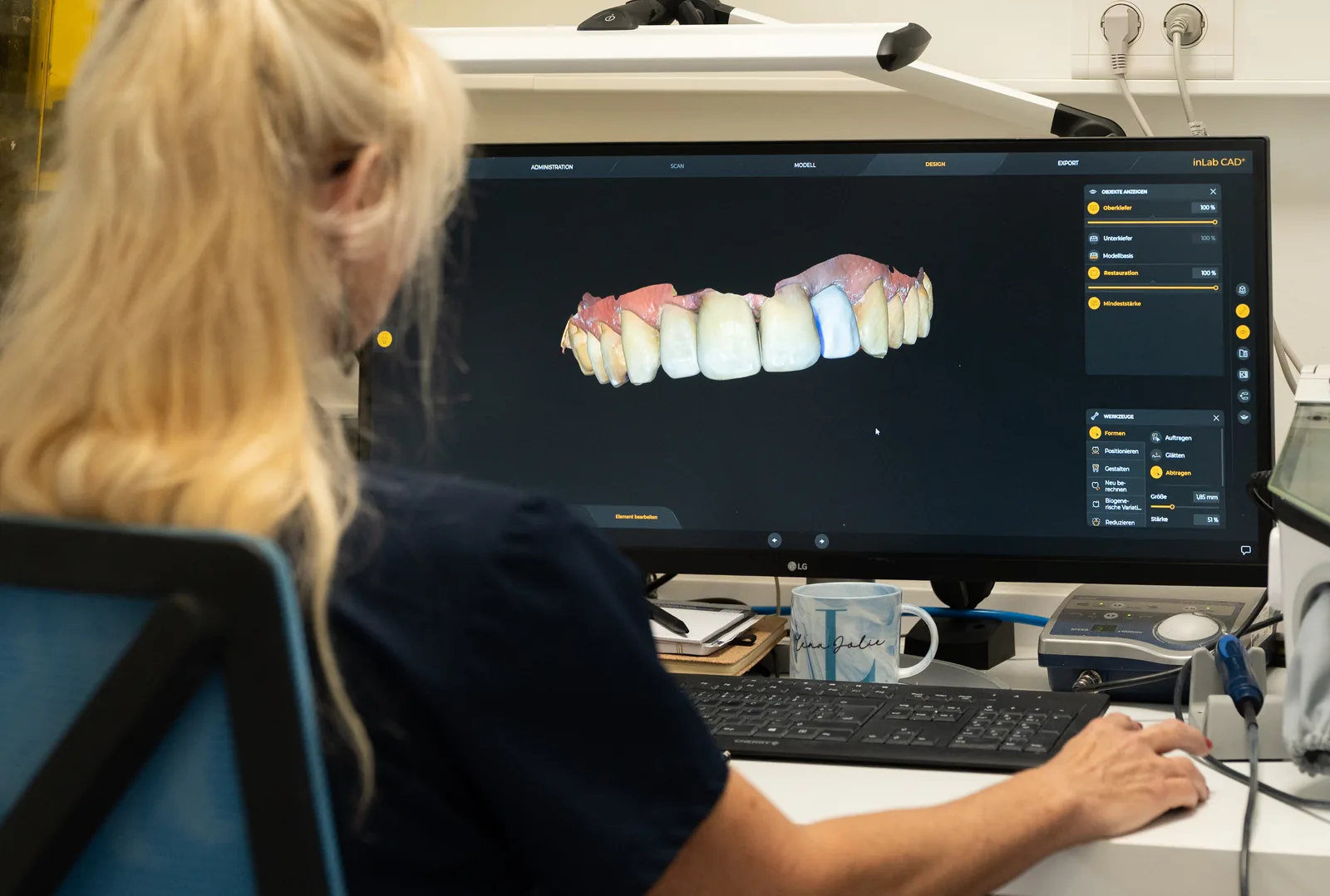
It starts with an intraoral scan: a small camera records your teeth in a few minutes, without an impression tray. From this data, the future crown, bridge or denture is designed on screen, matched to your bite and the neighbouring teeth. Only then does production begin.
3D printing
Everything that has to give shape but does not remain permanently in the mouth is printed:
- Models of your jaw as the basis for the further work
- Surgical guides for navigated implant placement, made to fit your teeth exactly
- Temporary restorations that you wear during the healing phase
- Splints for grinding or temporomandibular joint problems
- Try-ins that let you assess shape and tooth position in advance
Printing runs overnight. What used to take days is ready the next morning.
5-axis milling
Our milling machine moves the workpiece in five axes simultaneously. The decisive difference to simpler devices: it also reaches surfaces that are angled or undercut. This makes it possible to produce work that would otherwise have to leave the building:
- Crowns and bridges in zirconia or ceramic
- Telescopic crowns and bars for removable restorations
- Individual abutments on implants, shaped to your gums
- Denture bases, milled from a block rather than cast
Milling is done from a single piece of material. That is denser and more dimensionally stable than layered or cast material.
Zirconia
Zirconia is a high-strength ceramic. It is metal-free, well tolerated and lets light through, unlike a metal framework. For you that means: no dark edge at the gum line, no metals in the mouth and a material that also carries larger bridges.
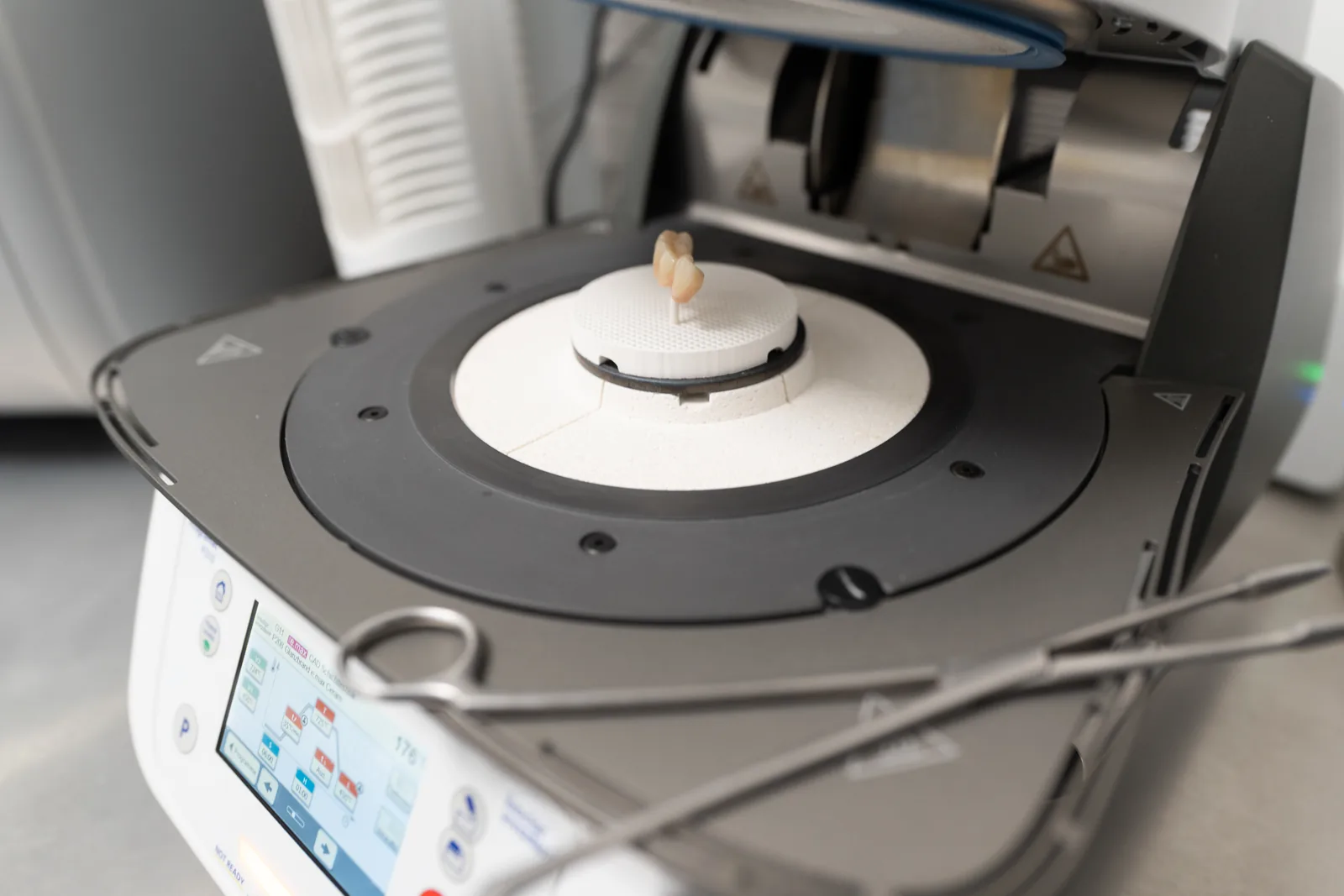
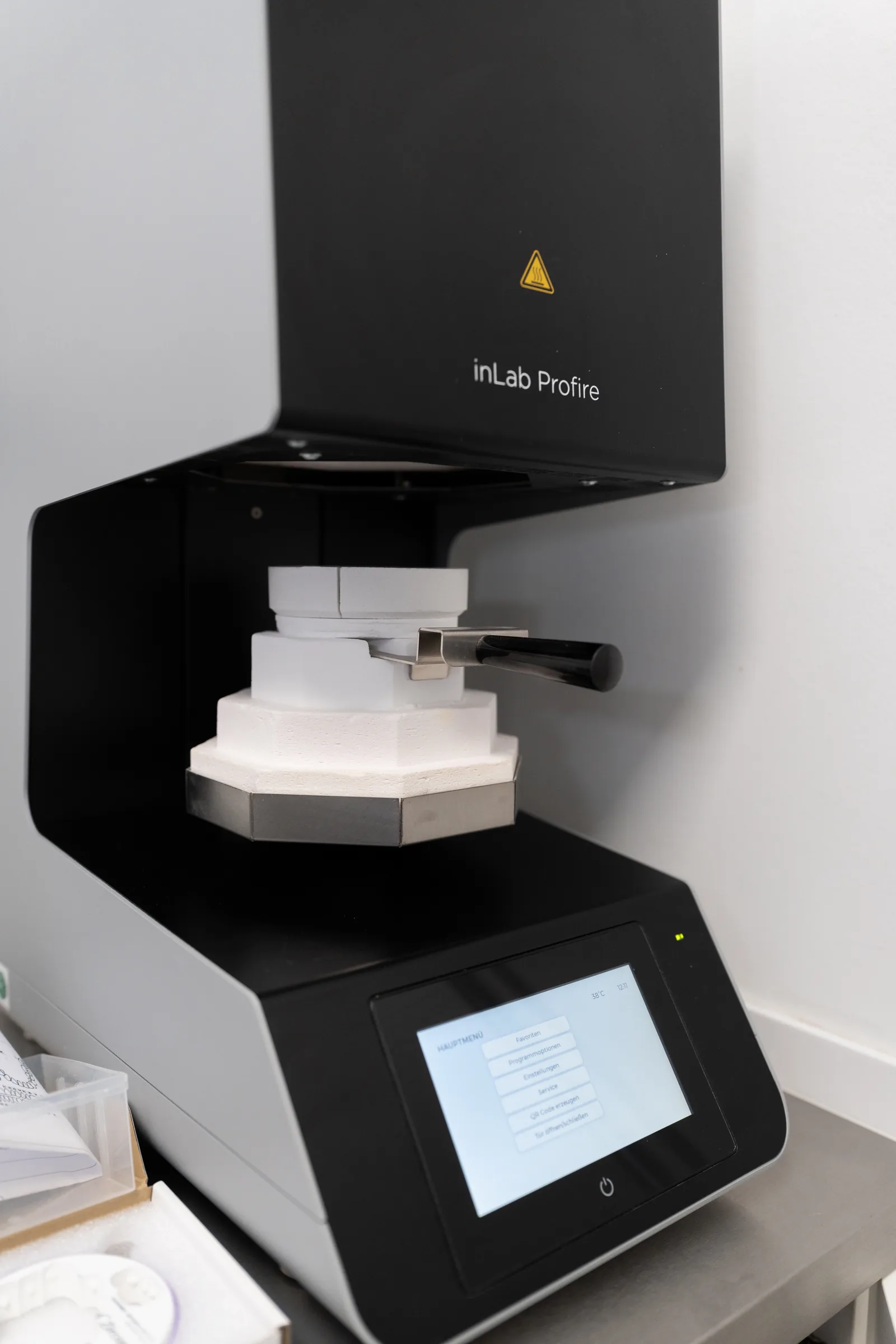
We work with multi-layer blanks in which colour and translucency already graduate from the root to the incisal edge, just as in a natural tooth. After milling, the work is densified in the sintering furnace at over 1,400 degrees and reaches its final strength in the process.
Multi-level ceramic: layered by hand
A natural tooth is never a single colour. At the neck it is stronger and more opaque, towards the incisal edge lighter and translucent, with fine colour transitions in between and sometimes small breaks in the enamel.
This is exactly what the layering technique reproduces: our master dental technician applies ceramic materials to the milled framework in several levels, each with its own colour and translucency, and fires them individually. For an anterior tooth that means several working steps and several firings.
We use this technique where it counts: for crowns and veneers in the visible area. In the posterior region, the fully anatomical milled crown is usually the better choice because it is more stable and offers less surface area for chipping. What makes sense in your case is something we discuss beforehand.
We determine the colour together. For the shade match, the technician comes to the chair, in daylight and with your own teeth as a reference. For demanding anterior work we also invite you to a try-in before the restoration is finished.
What is made in the laboratory
Crowns, bridges, veneers, inlays and onlays, implant-supported restorations, telescopic and Locator work, full and partial dentures, occlusal splints for temporomandibular joint problems and all temporary restorations. Repairs and relines as well, usually without you being without your restoration for more than a day.
Costs
The laboratory work is part of the respective out-of-pocket amount; the amounts are listed openly on the page What does what cost?, for example 1,160 € for a zirconia or ceramic crown. The written treatment and cost plan is always binding. On dentures and all other work from our practice we give a five-year guarantee if you attend the recommended prophylaxis and check-up appointments with us, except for damage caused by an accident or improper use; you receive the conditions in writing, and your statutory warranty rights remain unaffected.
Would you like to see how your restoration is made? Ask for a look into the laboratory at your next appointment. Appointment
