
Lower-radiation and more environmentally friendly images
In general, dental X-rays involve only a low radiation dose. Compared with analogue X-rays, digital X-rays are significantly lower in radiation still.
What's more, purely digital images don't need to be developed using chemical substances. Depending on the system used, no plastic film material is required either – making digital X-rays significantly more environmentally friendly.
Further advantages:
- The images are available immediately, and can be called up, analysed and discussed with you directly in any treatment room.
- Where needed, and with your consent, X-ray images can be sent quickly by email to colleagues (to clarify professional questions or for referrals). This saves you, and us, a great deal of time.
Single-tooth or panoramic X-rays
Depending on what's needed, X-rays can generally be taken either as single-tooth images or as what are known as panoramic images.
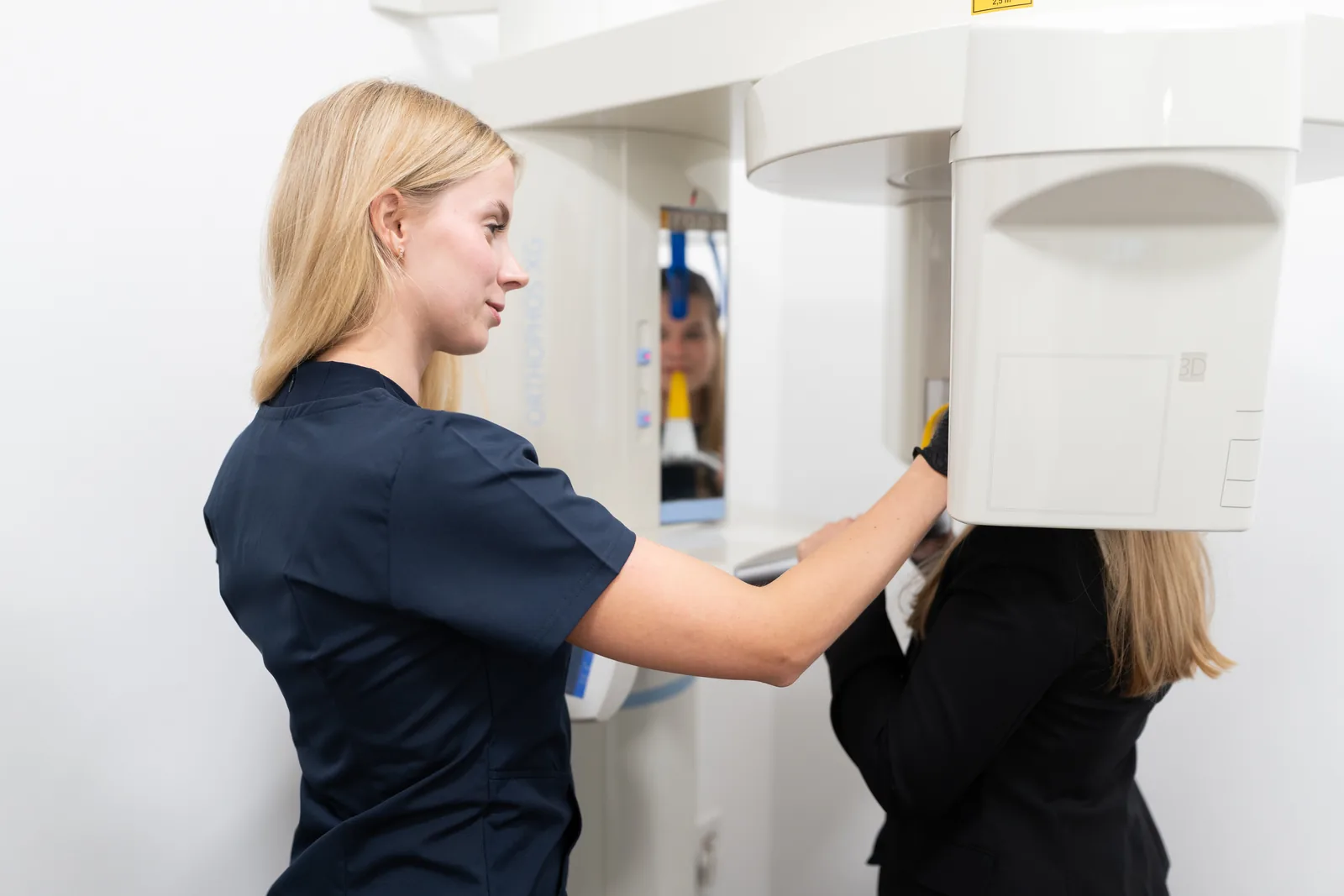
With single-tooth X-rays, one individual tooth is shown large and in great detail, together with its root and the surrounding jawbone. The interior of the tooth, including the root canals, is also visible. Panoramic X-rays (also known as overview images or “orthopantomograms”, OPG for short) show all the teeth, including the upper and lower jaw, the maxillary sinuses, and the jaw joints. A panoramic X-ray can, for example, reveal unerupted teeth or possible inflammatory processes in the periodontium or jaw. It also shows the root canals, though not in as much detail as a single-tooth image. Panoramic X-rays are produced in a single imaging process, in which the X-ray unit moves in a semicircle around your head.
