
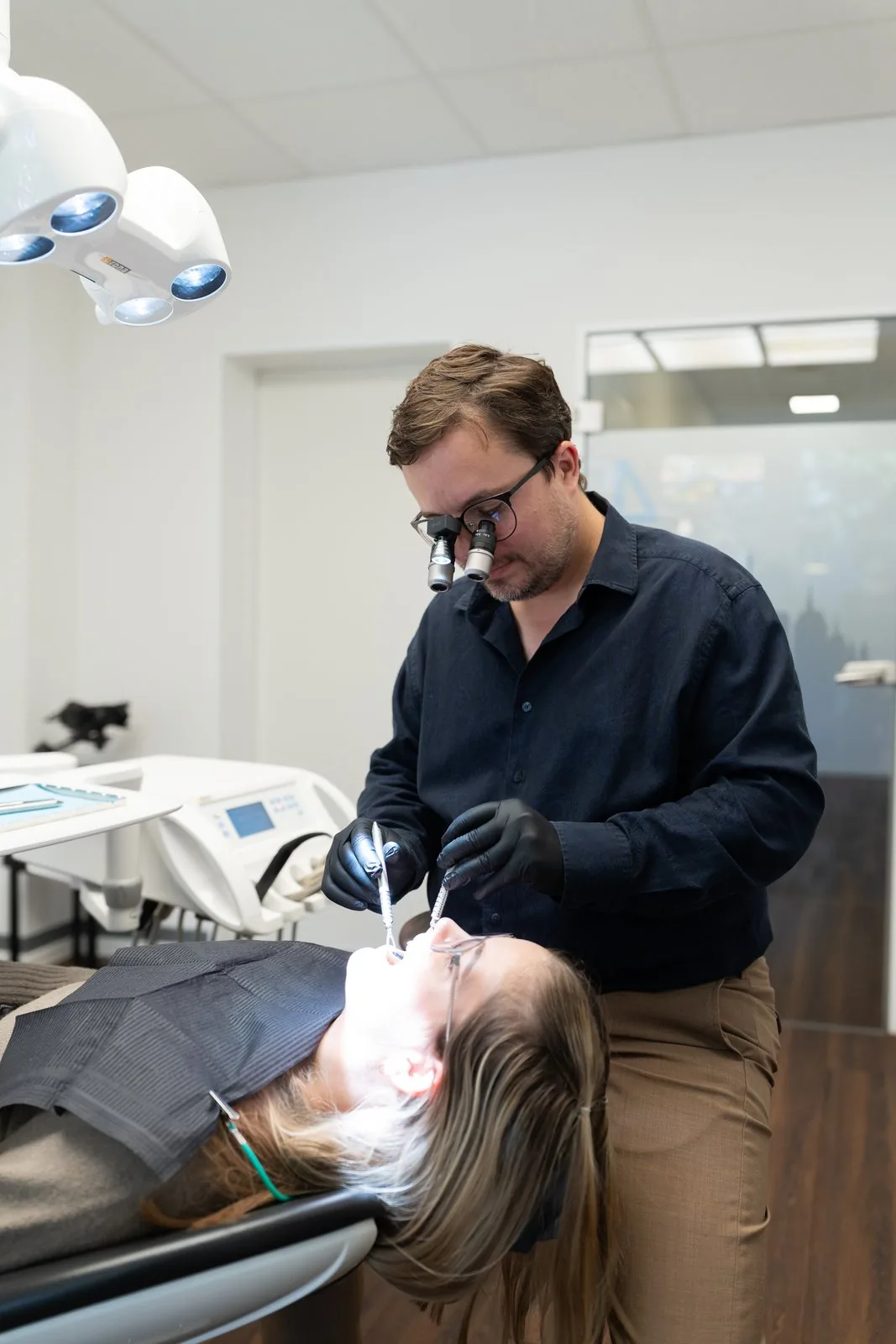
Explained in detail: On our dedicated page angstpatienten-weissenfels.de, you'll find all the details, videos and a 2-minute self-test to help you gauge your level of anxiety.
Book an introductory appointment online – no phone call needed
Three levels, and you have a say
- Treatment while awake, with plenty of time. Local anaesthesia, breaks on signal, a stop signal that is respected, and an explanation of every step.
- Sedation (twilight sleep). A sedative given through a vein ensures that you remain relaxed and largely untouched by the treatment; you breathe on your own and can respond. Most people remember hardly anything of the treatment.
- General anaesthesia. For extensive procedures such as several implants, a full-mouth rehabilitation or the removal of several teeth in one session, and for severe dental anxiety. You are unaware of the treatment.
Sedation and general anaesthesia are carried out by an anaesthesia team cooperating with us (specialist in anaesthesiology) on our practice premises, monitoring you continuously: circulation, breathing, oxygen, from the first moment until you wake up. Afterwards you rest with us until your companion collects you. We deliberately do not offer nitrous oxide; we rely on the three methods mentioned, which are easy to control.
The first appointment is an introduction, not a treatment
At the first visit we only look, talk and plan. You get to know the practice, your dentist and the rooms; we discuss your history and your wishes. An examination takes place only if you want one. Only then do we decide together which level suits you. You can book the appointment online, without having to call.
Safety, Preparation, Support
- Preliminary examination. Before sedation or general anaesthesia we clarify your health and medications, where needed in coordination with your GP.
- Fasting. Before sedation and general anaesthesia you must not eat for six hours; clear liquids are allowed until two hours beforehand. You receive precise instructions in writing and as a reminder on your phone.
- Companion. After sedation or general anaesthesia you may not drive for 24 hours; a companion takes you home.
- Emergency concept. In 2026 Dr. Strößner completed the basic and advanced course in sedation and emergency management of the German Society of Implantology; emergency equipment and a defibrillator are kept at the treatment station. Like any medical procedure, sedation or general anaesthesia carries risks; we inform you about these in person beforehand.
What does this cost?
Treatment while awake with local anaesthesia is covered by the statutory health insurance. If you choose sedation or general anaesthesia at your own request, the out-of-pocket amount depends on the duration: general anaesthesia up to one hour 300 €, up to two hours 480 €, up to three hours 640 € (as of March 2026), charged by the anaesthesia team under the German fee schedule for physicians (GOÄ). For certain findings, for example in children, certain illnesses or medically necessary procedures, the statutory health insurance covers the anaesthesia. You receive the treatment and cost plan for the dental treatment in advance and a separate cost overview for the anaesthesia; payment by instalments is possible through our partner BFS health finance. All amounts: What does what cost?
Especially Suitable For
- People with dental anxiety or bad experiences
- Patients with a strong gag reflex
- extensive treatments that would otherwise need many appointments
- Children for whom treatment while awake is not possible, in coordination with Dr. med. dent. Ricarda Müller, employed dentist with a focus on paediatric dentistry
- People who travel from further away and want to get everything done in one day
Are you coming from Leipzig or Halle?
If you come from Leipzig or Halle, you can combine the introductory appointment and the treatment: first the conversation, then on a second day the treatment under sedation or general anaesthesia, on Saturdays by arrangement. By car it is around 40 minutes via the A9, with parking right outside the door. More: From Leipzig and Halle to us.
Do you have questions? Write to us via the online reception, around the clock and without having to call, or call during opening hours: 03443 339 65 54. What happens after treatment is shown by the aftercare companion; your path as an anxious patient is described in the treatment roadmap.
Professionally responsible: Dr. med. dent. M.Sc. Sandro Strößner, dentist, Master of Science in Oral Implantology and Periodontology · Last reviewed: September 2026. These texts provide general information and do not replace an examination.
Video
Briefly explained – from our practice
The videos provide general information and do not replace individual advice; the course and outcome of treatment depend on personal circumstances. All videos have subtitles. More in our media library and on Instagram.
